Showing posts with label donation. Show all posts

Monday, April 13, 2009

Gillings' Global Research Gold Mine

It's been several months since my last post, but I assure you that Gillings' money has been hard at work "transforming" the School of Public Health - and apparently it's mission too. It was pointed out to me today that the bio for Dennis Gillings, who will be speaking at the North Carolina CEO Forum website includes the following:
In September, 2008, the School of Public Health at UNC Chapel Hill was named the Gillings School of Global Public Health. The mission is to advance the impact of economic and methodological research on health in both the developed and developing world.

That's funny, because the School of Public Health's website lists this as it's mission:
Our mission is to improve public health, promote individual well-being, and eliminate health disparities across North Carolina and around the world.

Maybe Gillings needs to send Rimer an e-mail and tell her to update it. I'm sure she'll get right on it. Seriously, there might be another few million dollars in it for the School, and with this economy, I'm sure she's desperate for funding. Of course as long as Gillings can find a way to get more bang for his buck by making a contribution to the School rather than signing a contract with it on Quintiles letterhead, I'm sure he will give more money. All bets are off if President Obama and Congress continue to discuss tightening the restrictions on tax deductible charitable contributions.

Gillings' money is currently funding 14 Gillings Innovation Labs, as they're called, 3 of which are related to work done by Quintiles. The first lab that was announced last year was the Center for Innovative Clinical Trials. The Center is the brainchild of Gillings himself, who met with Dean Rimer and select faculty members in late 2006, months before Gillings agreed to the $50 million contribution. At least two faculty members expressed greater interest in establishing a center for quantitative genetics and genomics, but apparently either Gillings was more interested in funding research regarding clinical trials, or at least the administration felt that way. The Center not only serves to speed clinical trials in an effort to
"serve the research needs of the industry community," but also to "have a direct impact on regulatory issues related to the FDA." According to the website, the Center for Innovative Clinical Trials will work closely with the Collaborative Studies Coordinating Center, which is directed by Lisa LaVange, former Vice President of Biostatistics at Quintiles. Gary Koch, professor of Biostatistics and co-founder of Quintiles, is listed as an expert for the Center for Innovative Clinical Trials, and Julie MacMillan, former Senior Vice President of Corporate Administration for Quintiles, is the Managing Director of Carolina Public Health Solutions, the entity created within the School to administer grant funding for the Gillings Innovation Labs (GIL). The other two projects that have received GIL funding are focused on vaccines and monitoring the effect of medications in elderly patients.

Gillings' influence is also apparent in the number of recent guest speakers who have been invited to talk about clinical trials or pharmaceuticals at the School. Robert Temple,
Director of the Office of Medical Policy of the FDA’s Center for Drug Evaluation and Research, delivered a talk titled "FDA Drug Approval Process, Potential Efficiencies and Active Control Trials" at the School on March 6, 2008. The School said Temple is "often described as one of the most influential officials in the U.S. Food and Drug Administration's drug regulatory process." Perhpas that's why Gillings and officials from Quintiles were interested in an exclusive opportunity to meet with Temple over dinner, following his talk. See pages 46 and 50 of misc.pdf for the invitation, and review other public records regarding Gillings influence over the School at: http://carolina.savethename.googlepages.com/uncschoolofpublichealth-publicrecords

Thursday, August 21, 2008

Competition Acquaints a University with Strange Bedfellows - CROs

Universities, particularly tax-payer supported institutions, exist to serve the public good through academic research, teaching, and service. Corporations are focused upon providing products and services to consumers, with the objective of creating a profit. While the two may have competing interests, universities and corporations frequently enter into agreements with one another. This often leads to potential conflicts of interest, as suggested by Jeanne Lenzer, a medical investigative journalist and the author of an article published today in the British Medical Journal.

The article calls attention to issues associated with research performed by academic and corporate contract research organizations (CROs). She cites examples of ethical concerns such as pitting commercial interests against those of individuals recruited to participate in clinical trials. Lenzer describes how in the PRECISION trial patients with cardiovascular disease are being given the drug celecoxib, a medication known to increase the risk of heart attack, stroke, and cardiovascular death, despite their already increased risk. In order to meet the criteria of clinical equipoise, one would have to believe that the potential benefit of reducing arthritis pain outweighs the known increased risk of death.

Another concern noted by Lenzer is that of exploitation of research subjects.
"CROs reduce costs partly by… recruiting participants from impoverished regions of the world."

Jean-Paul Garnie, former CEO of GlaxoSmithKline, was interviewed for the article and confirmed that CROs save money by taking trials overseas. Quintiles Transnational, a large CRO based in Durham, is guilty of recruiting participants in foreign countries for clinical trials as well. According to sources, including Reuters, Duke University's Center on Globalization, and Quintiles, the company has acquired status as the "global leader in pharmaceutical services" in part by expanding operations into Czech Republic, Romania, Thailand, the Phillipines, China, and India.

At a time when many Americans have difficulty affording medications, it is difficult to believe that the residents of these nations will have widespread access to these drugs beyond the trials.
"…even though public funds for research may often flow in the same directions as public funds for health care, it seems unfair that populations dependent on public health care constitute a pool of preferred research subjects if more advantaged populations are likely to be the recipients of the benefits."
-- The Belmont Report, National Commission for the Protection of Human Subjects of Biomedical and Behavioral Research

According to the principle of justice, individuals participating in trials, and the populations from which they are selected, should stand to benefit from the results.

Although not mentioned in the article, Quintiles has continued to grow in part by offering contract sales and information services, such as physician detailing and direct-to-consumer advertising. They have also invested capital into drug development in partnership with firms, including Solvay Pharmaceuticals and Eli Lilly, where their financial returns are tied to the success (or failure) of drugs, Cymbalta being one example.

In the final paragraphs of the BMJ article, Lenzer mentions the desire for CROs to form relationships with academic institutions, citing the example of Quintiles and UNC-Chapel Hill. The University’s affiliation with Quintiles and alignment with its founder and CEO, Dennis Gillings, are based upon sponsorship of forums, scholarships, internships, and corporate donations, as well as a $50 million pledge, that the School has accepted over the last decade.

In return for their apparent generosity, Quintiles and Gillings have been given the opportunity to participate in the planning of academic events held on the UNC campus (i.e. Driving the Future of Clinical Trials: Safer Drugs and Faster Approvals), to meet with officials such as Dr. Richard Temple, a director at the FDA’s Center for Drug Evaluation and Research who spoke at the School, to solicit information regarding the health care system in China from faculty for the purpose of developing a business strategy, and to influence the training of students at the School of Public Health.

The $50 million gift appears to be contingent upon renaming the School after Gillings, as well as basketball tickets to see the Tarheels play at home for the lifetimes of the Gillingses and their children. At least $750,000 of the pledge will be directed to the new Center for Innovative Clinical Trials. Gillings was given the opportunity to align his interests and those of Quintiles with the School by becoming involved in the planning of the Center. According to a letter from former Chancelor James Moeser to Gillings dated February 20, 2007, priorities of the "Gillings School of Global Health" will include "new methodologies to speed clinical trials…"

At least three current executives of Quintiles, including Dennis Gillings, and two of their spouses hold leadership positions at the School. While Dean Rimer has argued that they do not have the capacity to make decisions and are unbiased, it is apparent that they bear influence on the School by the nature of their appointments on the School of Public Health Advisory Council and the Acceleration Advisory Committee (AAC). Members of the AAC have no fiduciary responsibility to the School and thus are free to remain loyal to their personal interests and to those of their employer. Paula Brown Stafford, an executive vice president at Quintiles, serves as a member of the Public Health Foundation Board of Directors and is therefore involved in managing the School’s endowments and charitable gifts. Former Quintiles executive and current School of Public Health faculty member Lisa LaVange appears to have been recently relieved of her duty as a director for the Public Health Foundation. Julie MacMillan, a former Quintiles executive who has worked closely with Gillings in the past, currently serves as the Managing Director of Carolina Public Health Solutions, which Rimer describes as "the office we created to managed the [Gillings] gift."

Quintiles is not the only CRO with ties to UNC. Fred Eshelman, CEO of PPD, Inc. of Wilmington, has given over $30 million to the School of Pharmacy which has since been renamed.

Given the inherent conflicts of interest between universities and CROs, the relationship between UNC and Quintiles should be restricted from its current state, if not completely severed. Provisions should be made to ensure transparency and oversight by students, faculty, and alumni. Measures must be taken to guard against undue influence of current and former employees of Quintiles, including limiting the number of leadership positions to which they are appointed. Furthermore, the Gillingses should be removed from any and all positions at the School in which they might further influence how their gift is spent in an effort to preserve academic freedom and integrity as described by the American Association of University Professors.

Failure to implement these steps, as may become evident through a lack of leadership and moral courage within the School, will lead to an erosion of the core values of public health, including trust, respect, and social justice. If Carolina is to continue as a leading institution of public health, we must band together and speak out against the corporate corruption of our School.

Friday, May 9, 2008

UNC is (not) For Sale

In a front-page article published today in the Triangle Business Journal, Adam Linker reports that UNC School of Pharmacy plans to announce that it will be renamed after Fred Eshelman on May 21, 2008. The name change is scheduled to occur immediately following the announcement, allowing no time for public comment.

The article goes on to state that UNC and Eshelman essentially agreed in 2003 that the School of Pharmacy would be renamed after him. Fred Eshelman has given the School over $30 million, as announced in press releases from the University in February 2003, January 2008, and February 2008.

Eshelman is the founder and CEO of PPD, a global contract research organization based in North Carolina. Perhaps this is coincidental, but the future namesake of UNC School of Public Health, Dennis Gillings, is the founder and CEO of Quintiles, a similar corporation in competition with PPD.

I am deeply troubled by this news; especially the way in which UNC administrators have acted to create “transformative” changes, as they have been referred to by Deans Blouin and Rimer, in their respective schools without broad, public input from students, faculty, and alumni, and with limited transparency at best.

Students and faculty at the School of Public Health have been told by Dean Barbara Rimer that “rules and processes” have been followed and that faculty and alumni were consulted regarding the Gillings Gift. She has used the terms rigorous, fair, appropriate, checks and balances, respect, trust, and commitment to describe the process. I suggest that little evidence has been provided to support these statements and that the argument that faculty and alumni were involved is weak.

We have been led to believe that consultation with a handful of individuals in various leadership roles who also happen to be alumni, including members of the Public Health Foundation Board of Directors, and an as of yet undetermined number of faculty who were likely hand-picked by the administration, is sufficient to represent the interests of the thousands of alumni and over 250 faculty members of the School.

Not to mention the nearly 500 students at the school who have only just recently received a letter from Dean Rimer, and who have yet to be invited to participate in any forum specifically about the Gillings Gift, despite over 14 months having passed since it was announced in February 2007.

And what about the roughly 6.5 million taxpayers in the state who support the University of North Carolina year after year? They should be outraged at UNC’s decision to rename any of it’s schools after a donor considering the institution is the oldest public university in the nation and that it belongs to the people of North Carolina, not any individual, family, corporation, foundation, etc.

But back to the article in the Triangle Business Journal. Bob Blouin, dean at the UNC School of Pharmacy, in speaking about Eshelman says, “He’s been incredibly modest in his approach toward helping our school.” Since when does having your name plastered above the entrance to a major academic institution constitute modesty? And consider this, the School of Pharmacy Communications Office has included the following in their style guide, posted on the School’s website:
Eshelman, Fred: In 2003, Fred Eshelman gave $20 million to the School of Pharmacy, at the time it was the third largest gift in the University’s history and the largest gift ever to a U.S. pharmacy school. He is CEO and founder of Wilmington-based PPD Inc. Eshelman has asked that his name appear as Fred Eshelman in all uses, including the professorships that bear his name. Do not use his middle initial (N.) or his full first name (Frederic).

Fred Eshelman Distinguished Professorship: At Eshelman's request, we do not include his middle initial in the name of the professorship. These are $1 million professorships.

Modest? I think that’s a stretch, but you decide.

I will however offer you this. In the same news release announcing Eshelman’s donation of $20 million, UNC News Service mentions that one of the largest gifts to the university was “an anonymous $25 million gift to the School of Medicine” in 2001. I guess you can't ask that a school be renamed after yourself if you are an anonymous donor, but then again why would you want to?

The last comment I wish to call your attention to is this: “It has enabled us to compete at a new level.” This quote is from Dean Blouin in reference to the contributions made by Eshelman. It resembles a comment made by Dean Rimer to a group of students last month when she attempted to justify the Gillings Gift by explaining that the UNC School of Public Health is in competition with Johns Hopkins and other schools of public health.
I have read the mission statements for the UNC School of Public Health, the UNC School of Pharmacy, UNC Chapel Hill, and the University of North Carolina system and have yet to find where it states that our schools exist to compete with other institutions, or to compete at all. The preamble of the School of Public Health does state, “We are committed to remain the leading public School of Public Health in the United States” and the vision statement of the School of Pharmacy includes, “To be the preeminent school of pharmacy…” but I interpret these statements to mean that the schools will strive to be the best in their own right, not to actively engage in competition.

More importantly, the UNC system mission states that the multi-campus university is supposed to remain “dedicated to the service of North Carolina and its people.” I fail to see how renaming our schools, and potentially allowing private interests to corrupt the education and research being conducted at our public institutions, serves the State or its people.

Wednesday, March 19, 2008

What's In a Name?

The University of North Carolina School of Public Health in Chapel Hill is planning to change its name to the Dennis and Joan Gillings School of Global Public Health in September 2008.

So what? Why should anyone care?

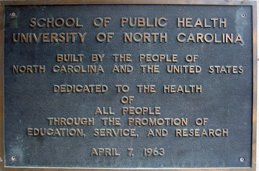
There are several reasons. Perhaps the most basic argument is that the University of North Carolina is a public institution, which means that it belongs to the people of North Carolina. In fact, UNC is the oldest public university in the United States and UNC School of Public Health was the first school of public health to be established at a state university. Short of honoring the school's founder, renaming a public institution in recognition of any individual, couple, or family disenfranchises the taxpayers, students, and alumni who fund the university every year.

In response to the fact that only about 30% of UNC School of Public Health's $104 million per year budget is derived from state funds, why take any action that might alienate donors? Past, present, and future donors should take offense to the planned name change as it bestows a greater importance upon a single major donor rather than the collective of donors who give varying amounts to the school, some probably year after year. I realize that $50 million is a lot of money, but that's less than half of the school's budget for just one year. You also have to consider the $36.6 million in research funding that the school secured through NIH grants in 2005 alone. And if anyone else was to consider making another multi-million dollar donation to the school, have the administration not set a precedent and should they not expect that the name of the school would be changed once again, in recognition of their donation? If the administration at UNC feels that recognizing donors is important, they should limit dedications to buildings, centers, scholarships, faculty endowments, and the like, not school names.

If you've ever stepped foot onto the Carolina campus or if you have ever been to a game in which the Tar Heels have played, then you know what Carolina pride is all about. Changing the name of the School of Public Health may disrupt the way that students, faculty, and alumni identify themselves. I have yet to talk to one person who anticipates being proud to say that they are an alum of Gillings, although most alumni of the School of Public Health are very proud of the fact that they graduated from UNC or Chapel Hill, as they often refer to the school. I would no sooner change the school colors or mascot, than would I change the school's name. What would you say if UNC had announced that Ramses' new name is Dennis or that Carolina blue is to be replaced with Gillings green? Furthermore, if the administration wants UNC School of Public Health to continue to stand apart from other schools like Johns Hopkins Bloomberg School of Public Health and Columbia University's Mailman School of Public Health, then why do exactly what they're doing by renaming the school after a benefactor? Do we really want to be know for some wealthy donor, or do we want to be known for our diversity of alumni and faculty who are leaders in public health?

After considering all of these arguments against the name change, think about this. It has been called to my attention that changing the name of the School of Public Health is only a symptom of a larger problem. Several people are concerned about the influence of industry and private dollars on the University, and rightfully so. Public-private partnerships are rife with ethical concerns and conflicts of interest. New York City Mayor Michael Bloomberg's donations of over $300 million to Johns Hopkins University is one thing, but at least he doesn't have a financial interest tied to the research of Hopkins' School of Public Health in the way that Dennis Gillings does with respect to the pharmaceutical and biotechnology contract research organization, Quintiles, and UNC.

These are just a few of the serious concerns and reservations that I have with regard to the "Gillings Gift" and the UNC School of Public Health name change. I'm sure that you can come up with others, and I hope that you will choose to share them, just click on the "comments" link below.